
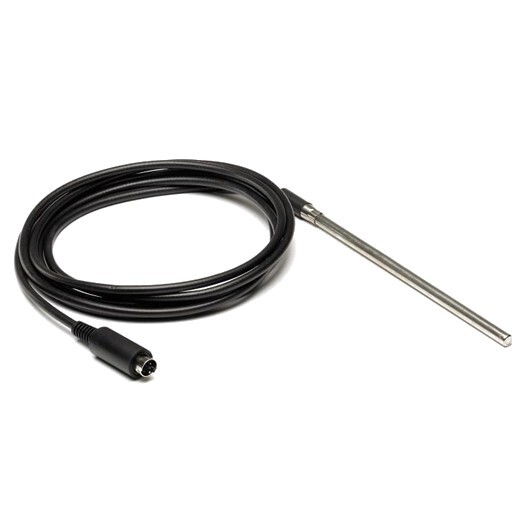
PT100 probe, 1/10 DIN accuracy, 2 m
Precision You Can Trust
NABL-Accredited Calibration | Available on Request
The Pico SE012 PT100 Probe is a high-precision platinum resistance thermometer designed for accurate temperature measurement from −50 °C to +250 °C. It provides 1/10 DIN accuracy of ±0.03 °C at 0 °C, a 150 mm × 4 mm stainless-steel probe, four-wire construction, a 2 m PTFE cable and a 4-pin mini-DIN connector for direct use with compatible Pico temperature data loggers..
- Detail
- Special Features
- Specification
The Pico SE012 PT100 Probe with 1/10 DIN accuracy and 2 m cable is designed for applications where higher temperature-measurement accuracy is required than a standard Class A or Class B PT100 probe can provide.
Pico Technology specifies the SE012 as a high-precision platinum resistance thermometer (PRT) with an accuracy of ±0.03 °C at 0 °C and a measurement range from −50 °C to +250 °C.
The probe is recommended for use with the Pico PT-104 High-Accuracy Temperature Data Logger, making it suitable for laboratory, research, calibration and engineering applications that require stable and repeatable temperature measurement.
High-Precision 1/10 DIN PT100 Measurement
The key advantage of the SE012 is its 1/10 DIN tolerance specification.
At 0 °C, Pico specifies:
- Accuracy: ±0.03 °C
- Accuracy class: 1/10 DIN
This is significantly tighter than Pico's standard Class A PT100 probes, which are typically specified at ±0.15 °C at 0 °C.
The higher accuracy makes the SE012 particularly useful for:
- Precision temperature logging
- Calibration-related measurements
- Laboratory testing
- Thermal characterization
- Environmental chamber validation
- Scientific experiments
- High-accuracy process monitoring
−50 °C to +250 °C Temperature Range
The SE012 supports a published measurement range of:
- Minimum temperature: −50 °C
- Maximum temperature: +250 °C
This range makes the probe suitable for both below-ambient and elevated-temperature measurements.
Typical applications include:
- Laboratory temperature monitoring
- Thermal chambers
- Liquid and air temperature measurements where probe construction is appropriate
- Electronics thermal testing
- Equipment temperature monitoring
- Industrial experiments
- Research and development
- Temperature reference measurements
Stainless-Steel Probe
The sensing probe is manufactured from stainless steel.
Pico specifies the probe dimensions as:
- Probe length: 150 mm
- Probe diameter: 4 mm
The slim 4 mm probe diameter makes it suitable for measurement points where a relatively narrow sensing element is required.
2 m PTFE Cable
The SE012 is supplied with a:
- 2 metre PTFE cable
PTFE cable insulation is suitable for the published operating temperature range of this probe and provides flexibility when the measurement point is positioned away from the data logger.
The 2 m lead is useful in:
- Environmental chamber testing
- Laboratory benches
- Process equipment
- Remote measurement points
- Test fixtures
- Temperature-monitoring installations
Four-Wire PT100 Construction
The SE012 uses a 4-wire connection.
Four-wire PRT measurement is preferred for high-accuracy temperature measurements because the measurement instrument can compensate for resistance in the connecting leads.
This is particularly important with precision PT100 sensors, where even small amounts of cable resistance can otherwise contribute to measurement error.
The four-wire design is therefore well matched to the high-accuracy capability of the Pico PT-104 data logger.
4-Pin Mini-DIN Connector
The SE012 is fitted with a:
- 4-pin mini-DIN connector
This connector allows direct connection to compatible Pico temperature data-logging equipment such as the PT-104.
The term “1/10 DIN” does not describe the connector. It refers to the probe's temperature-accuracy tolerance class.
Recommended for Pico PT-104
Pico Technology lists the SE012 as a recommended temperature sensor for the PT-104 High-Accuracy Temperature Data Logger.
The PT-104 supports high-resolution PT100 and PT1000 measurements, while the SE012 provides the precision PRT sensor needed to take advantage of high-accuracy temperature-logging applications.
This combination is suitable for:
- Precision temperature acquisition
- Multi-point PT100 measurements
- Research laboratories
- Calibration work
- Environmental testing
- Product qualification
- Long-duration temperature monitoring
Complete Measurement Accuracy
When using the SE012 with a data logger, overall system accuracy depends on both:
- Probe accuracy
- Data logger accuracy
The SE012 itself is specified at ±0.03 °C at 0 °C.
For high-accuracy applications, users should consider the combined uncertainty of the probe, logger, installation conditions and any applicable calibration data rather than treating the probe specification alone as the complete system accuracy.
No Handle Design
Pico specifies:
- Handle: No
The SE012 consists of the stainless-steel sensing probe connected directly to its PTFE cable rather than using a separate hand-held probe handle.
This configuration is suitable for fixed, semi-permanent and laboratory measurement installations.
Typical Applications
The Pico SE012 is suitable for:
- High-accuracy temperature measurement
- PT100 temperature logging
- Calibration laboratory measurements
- Scientific research
- Environmental chamber testing
- Electronics thermal characterization
- Product temperature validation
- Laboratory experiments
- Industrial temperature monitoring
- Process temperature measurements
- Equipment thermal studies
- Long-duration temperature recording
- Multi-channel PT-104 measurements
- Research and development
- Quality-control testing
1/10 DIN High Accuracy
The SE012 provides:
- ±0.03 °C accuracy at 0 °C
- 1/10 DIN tolerance
This is the main performance advantage of the probe and makes it suitable for precision measurements where a standard Class A PT100 sensor may not provide sufficient accuracy.
PT100 Platinum Resistance Sensor
The SE012 is a PT100 platinum resistance thermometer.
PT100 sensors are widely used for precision temperature measurement because of their predictable resistance-versus-temperature characteristics and long-term stability.
−50 °C to +250 °C Range
The probe provides a broad working range suitable for many research, laboratory and industrial applications:
- −50 °C to +250 °C
Four-Wire Measurement Configuration
The probe uses:
- 4 wires
A four-wire configuration helps minimize measurement error caused by lead resistance when used with a compatible four-wire PRT measurement instrument.
150 mm Stainless-Steel Probe
The sensing assembly has a:
- 150 mm probe length
- 4 mm probe diameter
- Stainless-steel construction
This provides a compact probe form for a range of precision temperature-monitoring applications.
2 m PTFE Cable
The probe is supplied with a:
- 2 m cable
- PTFE cable insulation
The longer cable provides flexibility when installing the probe away from the measurement instrument.
4-Pin Mini-DIN Connector
The SE012 uses a 4-pin mini-DIN connector for connection to compatible Pico instrumentation.
This allows straightforward connection to the PT-104 without requiring a separate bare-wire terminal adapter.
Recommended PT-104 Accessory
Pico Technology officially lists the SE012 among the recommended probes for its PT-104 High-Accuracy Temperature Data Logger.
Multiple SE012 probes can therefore be used with available PT-104 channels for multi-point high-accuracy temperature logging.
Suitable for Precision Temperature Systems
The combination of:
- 1/10 DIN accuracy
- Four-wire construction
- Stainless-steel probe
- PTFE lead
- Mini-DIN connection
makes the SE012 suitable for precision measurement systems where both sensor accuracy and installation quality are important.
No Separate Probe Handle
The manufacturer specifies the SE012 with:
- Handle: No
This makes it appropriate for installed, fixture-mounted and laboratory measurement setups rather than applications requiring a hand-held probe body.
| Specification | Details |
|---|
| Manufacturer | Pico Technology |
| Model / Order Code | SE012 |
| Product Name | PT100 Probe, 1/10 DIN Accuracy, 2 m |
| Product Type | High-Precision Platinum Resistance Thermometer / PT100 Probe |
| Sensor Type | PT100 |
| Accuracy Class | 1/10 DIN |
| Accuracy at 0 °C | ±0.03 °C |
| Temperature Range | −50 °C to +250 °C |
| Probe Length | 150 mm |
| Probe Diameter | 4 mm |
| Cable Length | 2 m |
| Probe Material | Stainless steel |
| Cable Material / Insulation | PTFE |
| Connector | 4-pin mini-DIN |
| Number of Wires | 4 |
| Handle | No |
| PT-104 Compatibility | Recommended accessory |
| Primary Applications | Precision temperature logging, laboratory testing, calibration-related measurements and thermal monitoring |